
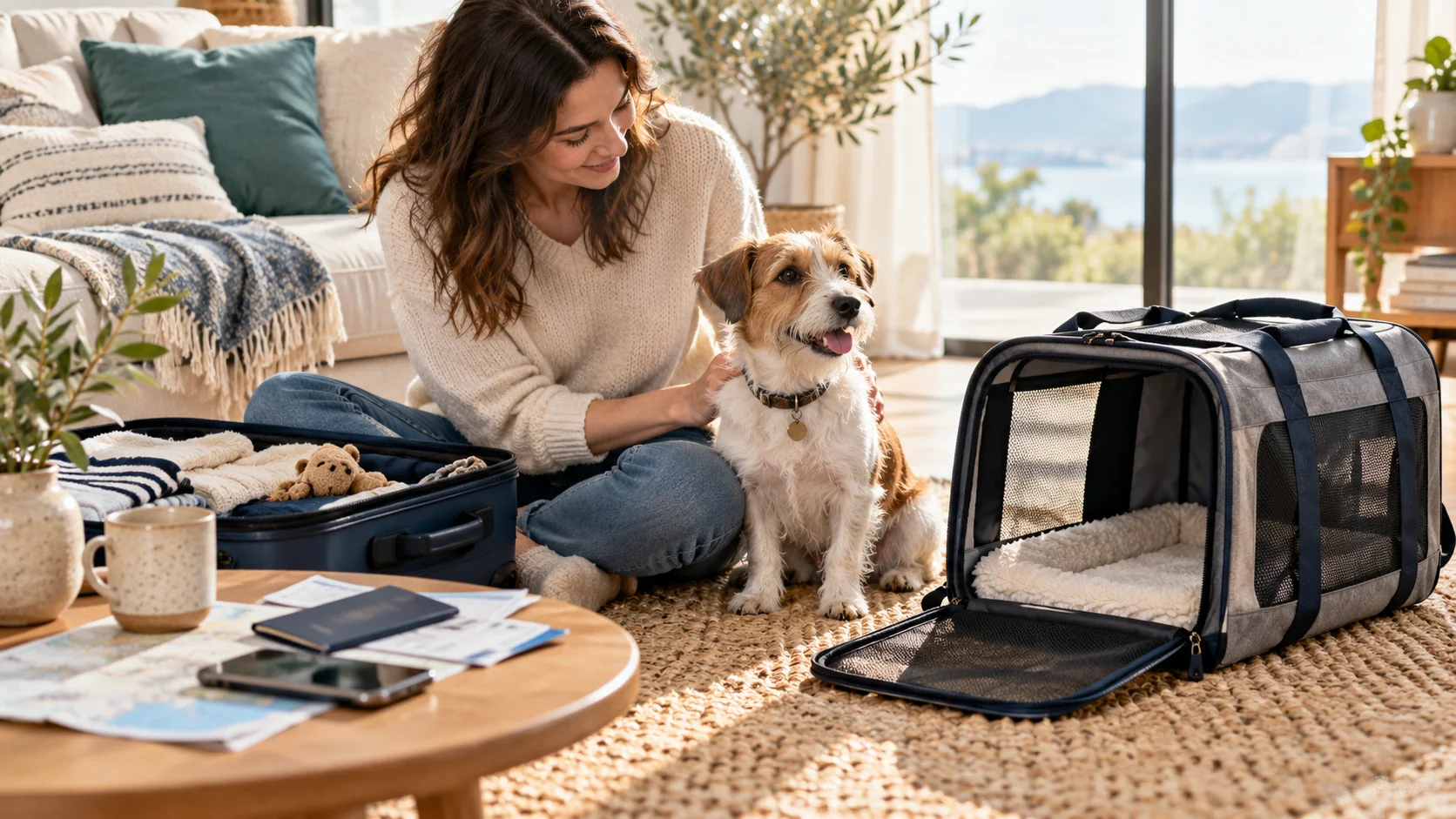
When people start planning a flight with a dog or cat, one of the first purchases is often the carrier.
It feels productive. It is tangible. It makes the trip feel real.
But the carrier should rarely be the first decision.
The more useful starting point is the trip itself: which airline, which route, what type of pet, what destination rules and what travel conditions will shape what is actually allowed?
Pet travel is one of those categories where the order of planning matters as much as the planning itself.
1. Start with the route, not the gear
Before buying anything, map the real journey.
That means more than writing “New York to Paris” or “Miami to Buenos Aires.”
Look at:
- origin and destination airports;
- whether the itinerary is nonstop or connecting;
- which airline operates each segment;
- whether a codeshare is involved;
- how long the connection is;
- and whether the trip crosses a border with additional animal-entry requirements.
A carrier that works for one aircraft, airline or travel method may not work for another.
The route creates the rules the gear has to satisfy.
2. Confirm how your pet is eligible to travel
Travelers often use “flying with my pet” as if it were one universal process.
It is not.
Airlines can have different rules for cabin travel, checked animals, cargo transport, species, breed, age, weight, carrier dimensions and seasonal restrictions.
The important habit is simple:
Do not rely on a generic pet-travel checklist when the airline’s current rule is the actual requirement.
Use general planning tools to organize the process, but verify the final rule directly with the airline and destination authorities before booking or buying equipment.
3. Check destination requirements early
The flight is only one part of the trip.
Depending on the destination, you may need veterinary documentation, vaccinations, certificates, microchip information, import permits or specific timing around health paperwork.
The point is not to memorize every possible rule.
The point is to identify early whether your destination has a process that affects your booking timeline.
If a document has to be issued within a certain window, that date belongs in the travel plan just like a flight or hotel confirmation.
4. Buy the carrier after you know the constraints
Now the carrier decision becomes much easier.
Instead of asking, “Which pet carrier has the best reviews?” you can ask:
- What dimensions does my actual airline allow?
- Does my pet fit comfortably within those limits?
- Is the carrier soft-sided or hard-sided based on the travel method?
- Can it be handled easily through the airport?
- Does it give the pet enough ventilation and stability?
- Have I tested it before travel day?
The best carrier is not the one with the most features.
It is the one that fits your pet + your airline + your route + your travel method.
5. Plan the airport experience, not only the flight
A pet does not experience the trip as a reservation number.
They experience a sequence:
home → transportation → airport → security or check-in → waiting → boarding → flight → arrival → ground transportation → new environment.
Every transition adds friction.
Think through practical questions before departure:
- When will your pet eat?
- When will they have access to water?
- Where can they relieve themselves?
- How long will they be inside the carrier?
- What happens during a delay?
- What supplies need to stay in your personal item?
- What does your pet need to feel familiar and calm?
A good plan reduces improvisation for both the traveler and the animal.
6. Build a backup for delays and denied assumptions
Pet travel has more dependencies than a normal passenger itinerary.
That means a small assumption can become a big problem.
Useful backups include:
- the airline’s pet-policy page saved offline;
- confirmation that the pet reservation is attached correctly;
- copies of required documents;
- an alternate ground-transport option;
- a plan for a long delay;
- contact information for a veterinarian at home;
- and a clear list of what must stay accessible during travel.
The goal is not to expect the worst.
It is to avoid making high-stress decisions with missing information.
7. Practice before departure day
The first time your pet spends meaningful time in the carrier should not be at the airport.
Introduce the carrier early.
Let it become familiar. Practice short periods. Practice movement. Practice the routine you expect to use on the day of travel.
A technically compliant setup can still be a poor travel experience if the pet has never encountered it before.
Planning is partly regulatory, but it is also behavioral.
The better order
A simple sequence looks like this:
route → airline rules → destination requirements → pet eligibility → documentation timeline → carrier → airport routine → backup plan
That order prevents the most common planning mistake: buying first and verifying later.
Product bridge
The Pet Flight Planner is built around that decision order. It gives travelers one place to organize airline rules, documentation, carrier checks, timing and the practical details that are easy to scatter across tabs and screenshots.