
Peak season creates a specific kind of operational pressure for travel advisors: different kinds of work become urgent at the same time.
You may be promoting holiday offers while answering new inquiries, collecting final payments, checking documents for booked travelers, reconfirming suppliers and preparing clients for departures.
Every task matters. The problem is that they do not belong to the same workflow.
When everything lives in one long task list, the advisor has to decide what each item means every time it appears. That is where seasonal chaos begins.
Separate selling from servicing
Holiday marketing and booked-traveler operations have different objectives.
A campaign needs an offer, audience, message, CTA and follow-up path.
A booked trip needs payments, documents, confirmations, traveler communication and final-readiness checks.
If both are mixed together, marketing tasks can hide operational deadlines and client-service tasks can consume every hour that was supposed to generate new business.
Separate the two views even if the information ultimately belongs to the same business system.
Give inquiries a fast lane
Peak-season leads often arrive with more urgency than a normal inquiry.
Dates may be close. Availability may be moving. Several family members may be involved. The traveler may already have compared options elsewhere.
That does not mean every inquiry deserves emergency treatment. It means you need a fast way to see which ones require an immediate next action.
Capture the minimum useful information: travel window, party, destination or trip type, decision status and the next step.
The goal is to prevent a high-intent inquiry from sitting beside low-priority admin work simply because both are “tasks.”
Put deadlines beside the traveler they affect
A calendar can show that something is due. It does not always show why the deadline matters.
Final payment, passport check, supplier reconfirmation, insurance decision, document delivery and pre-departure communication should be visible in the context of the booking.
That lets you understand the operational consequence immediately.
A deadline without context creates another research step. During peak season, those extra steps accumulate quickly.
Schedule communication before clients have to ask
Reactive service expands under pressure.
When travelers are nervous about holiday travel, they may ask the same questions at different times: Is everything confirmed? What happens next? When do we receive documents? What should we do if something changes?
A planned communication rhythm reduces that uncertainty.
Decide which messages should happen automatically in your workflow: booking confirmation, payment reminder, document check, final-readiness update, departure message and any seasonal guidance relevant to the trip.
You are not trying to send more messages. You are deciding in advance which communication prevents confusion.
Build a disruption watch before the busiest weeks
Holiday travel brings more moving parts, and the advisor needs a clear distinction between routine updates and issues that require action.
A supplier email, schedule change, cancellation, missed connection risk or service disruption should not disappear inside ordinary inbox volume.
Define what deserves escalation and what can simply be logged.
The system should help you see which traveler is affected, what changed and what action is next.
Protect time for revenue and service
Peak season can make every day feel like client service.
If you do not protect time for campaigns, follow-up and future-trip leads, the pipeline can become empty just as the current wave of travelers departs.
The reverse is also true: aggressive selling without operational capacity creates a service problem.
A seasonal workflow needs both sides visible at the same time: sell the season and serve the travelers already in it.
Build the season before it becomes urgent
Holiday travel is predictable even when individual bookings are not.
The dates change every year, but the categories of work repeat: offers, inquiries, booked travelers, payments, documents, communication, support and future-trip opportunities.
That repetition is exactly why the season deserves its own operating structure.
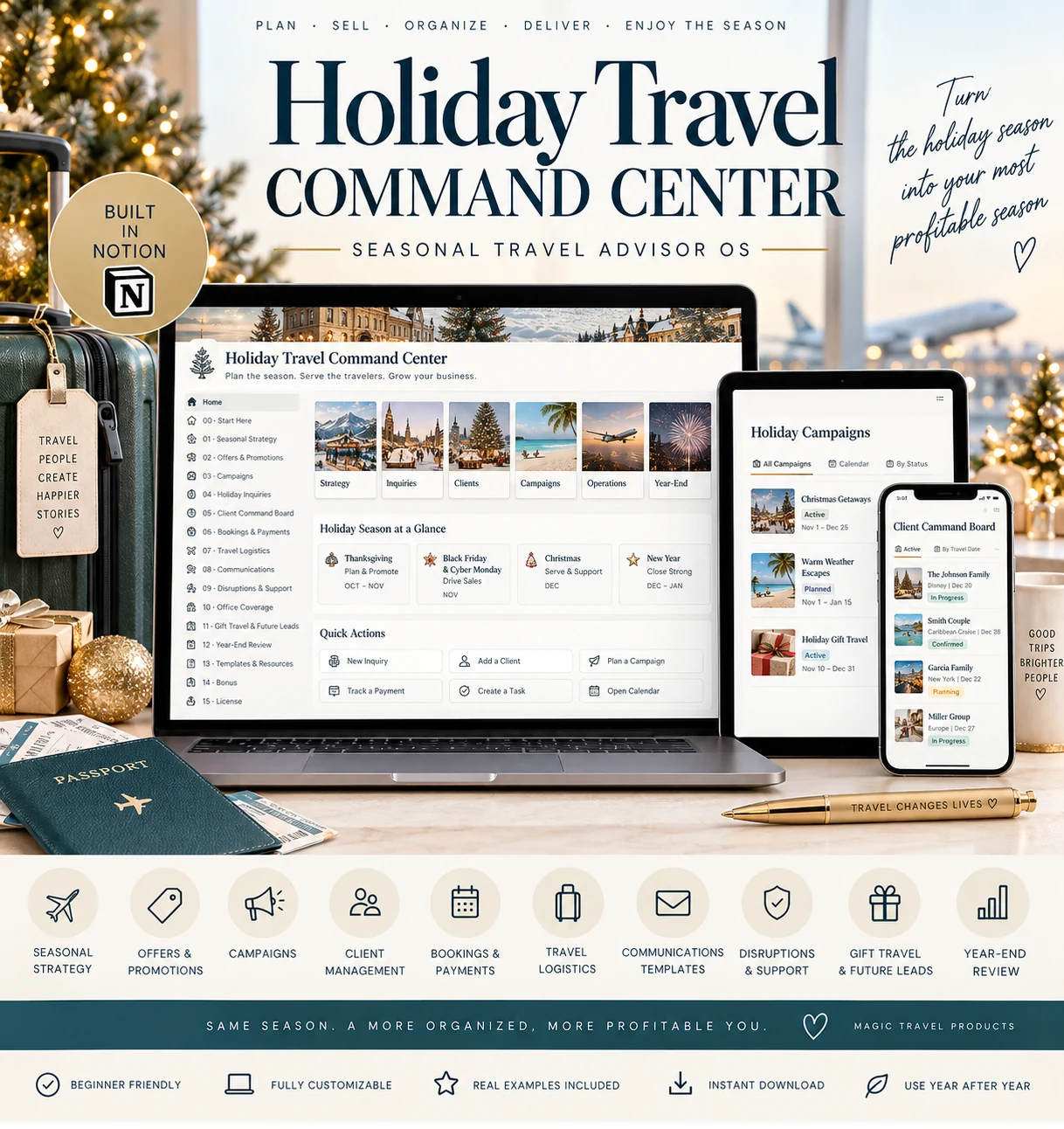
The Holiday Travel Command Center is built for travel advisors managing that overlap. It brings seasonal strategy, campaigns, inquiries, booked travelers, deadlines, communication and peak-season support into one reusable Notion system.